AI Caught My Forgotten Subscriptions: How to Find and Cancel Charges You Didn't Know You Were Paying
The average person wastes $200-300 per year on subscriptions they forgot about. AI subscription trackers are changing that by scanning your transactions and surfacing charges you stopped using months ago.
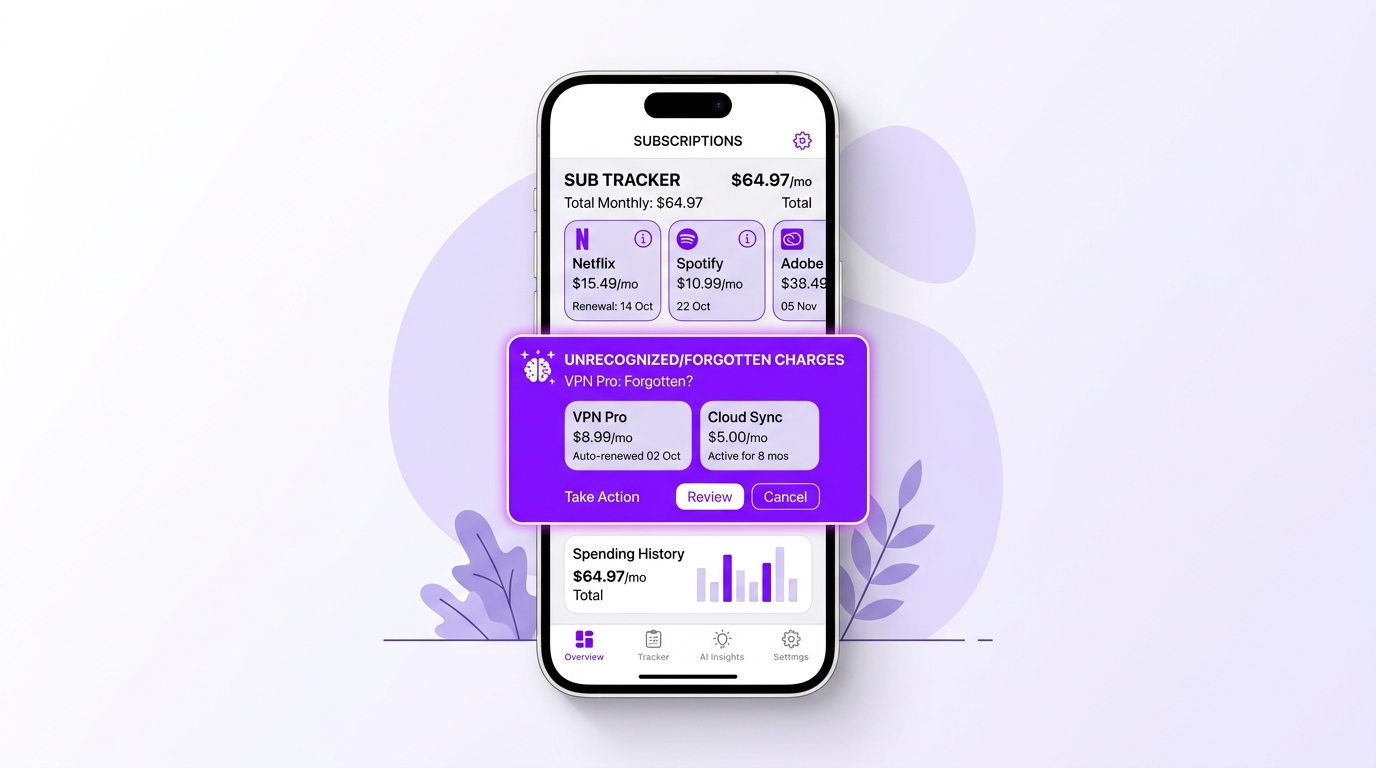
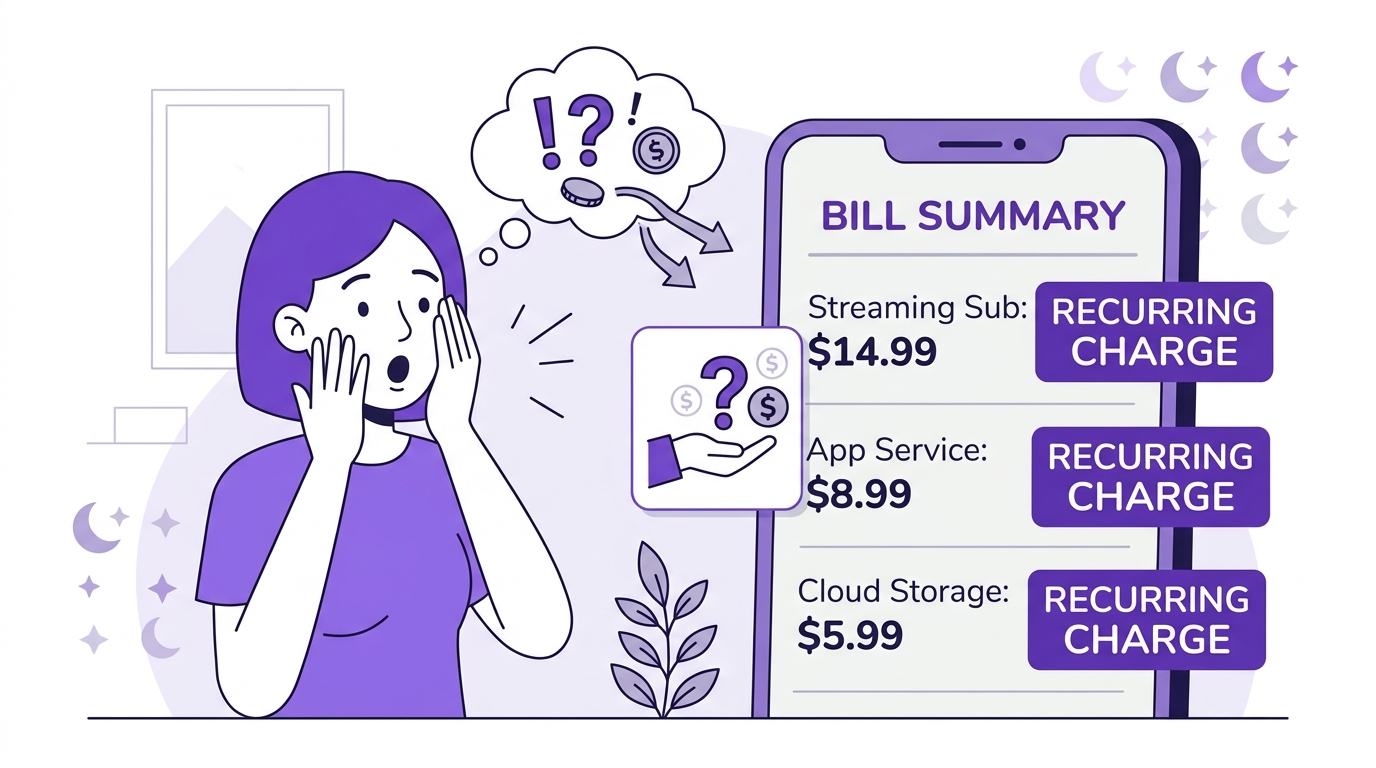
Here is a scenario that happens more often than anyone wants to admit: you sign up for a free trial of a cloud storage service because you needed to transfer some files. Three months later, you are paying $9.99/month for 2TB of storage you have not touched since that one file transfer. Multiply that pattern across streaming services, productivity apps, fitness memberships, and news subscriptions, and you are looking at $200-300 per year silently draining from your bank account.
A 2025 C+R Research study found that 42% of consumers are paying for at least one subscription they forgot about. West Monroe Partners reported the average American underestimates their monthly subscription spending by $133 per month — that is not a rounding error, that is an entire extra subscription budget hiding in plain sight.
AI subscription trackers solve this by doing what humans are terrible at: systematically reviewing every recurring charge, comparing it against your actual usage patterns, and flagging the ones that no longer make sense.
Why Forgotten Subscriptions Are So Common
The subscription economy is designed to be frictionless going in and difficult going out. Companies invest heavily in seamless sign-up flows and free trial conversions precisely because they know most people will not actively cancel. This is not a conspiracy theory — it is the documented business model behind subscription-based SaaS, streaming, and membership services.
Several factors make forgotten subscriptions nearly inevitable:
- Free trial auto-conversion. You sign up for 7 or 14 days free, forget to cancel before the trial ends, and suddenly you are paying monthly. Most services bury the cancellation option three menu levels deep.
- Annual billing amnesia. Yearly subscriptions are particularly sneaky. You signed up for a design tool in January, stopped using it by March, and won't see the renewal charge until next January — when it charges another full year automatically.
- Multiple payment methods. When charges are spread across two credit cards, a debit card, and PayPal, no single statement shows the full picture. A $4.99 charge on a card you rarely check goes unnoticed for months.
- Micro-charges. A $2.99/month app subscription does not trigger the same alarm as a $200 charge. But twelve of them add up to $430/year.
- Family account sprawl. Family members sign up for services on shared payment methods. One person's forgotten Duolingo Plus becomes the household's invisible line item.
How AI Subscription Tracking Works
Traditional subscription tracking requires you to manually audit your bank statements — tedious work that most people do once, maybe twice, and then abandon. AI flips this by automating the detection and ongoing monitoring. Here is the technical breakdown of what a good AI subscription tracker actually does:
1. Recurring Pattern Detection
The AI scans your transaction history and identifies charges that repeat at regular intervals. This goes beyond simple exact-amount matching. A smart tracker recognizes that a charge of $14.99 in January, $15.99 in February (after a price increase), and $15.99 in March are all the same subscription — not three separate purchases.
2. Usage Correlation
Advanced trackers cross-reference subscription charges with your engagement patterns. If you are paying for a music streaming service but have not opened the app in 60 days, the AI flags it as potentially forgotten. This requires more than just transaction data — it needs behavioral signals.
3. Free Trial Monitoring
The AI tracks when free trials are set to convert to paid subscriptions and alerts you before the charge hits. This is arguably the highest-value feature, because it prevents the forgotten subscription from ever starting.
4. Price Increase Alerts
Subscriptions quietly raise prices more often than you think. Netflix, Spotify, YouTube Premium, and dozens of SaaS tools have all increased prices in the past two years. An AI tracker catches these changes immediately and asks if the service is still worth the new price to you.
5. Annual Renewal Forecasting
For yearly subscriptions, the AI tracks renewal dates and sends reminders weeks in advance. This gives you time to evaluate whether you still need the service before the charge goes through, rather than discovering it after the fact when refunds may not be possible.
What to Look for in an AI Subscription Tracker
Not every app that claims to track subscriptions uses genuine AI. Here is how to separate real intelligence from marketing labels:
- Adaptive detection. The tool should find subscriptions you did not manually add. If you have to enter every subscription yourself, the "AI" is just a spreadsheet with a nicer interface.
- Learning from corrections. When you tell the tracker "this is not a subscription, it is a recurring grocery delivery," it should remember that for future transactions. Real machine learning improves with feedback.
- Cross-account visibility. The tracker needs to aggregate across all your payment methods. A subscription tracker that only sees one credit card misses the charges on your other cards and PayPal.
- Proactive alerts. The best trackers do not wait for you to open the app. They send notifications when they detect a new recurring charge, a price increase, or an upcoming renewal.
- Cost summarization. A clear view of your total monthly and annual subscription spend, sortable by amount, category, and last usage date.
Best AI Subscription Trackers in 2026
1. kNexo — Best for Comprehensive AI Finance + Subscription Tracking
kNexo combines AI subscription detection with full expense tracking and gamified budgeting. The AI identifies recurring charges across all connected accounts, flags unused subscriptions, and calculates your true subscription cost. The WhatsApp integration lets you ask "what subscriptions am I paying for?" and get an instant breakdown without opening the app.
Free tier includes subscription detection and bank sync. Plus plan ($19.90/month) adds unlimited AI insights, advanced analytics, and priority alerts for trial conversions and price increases.
2. Copilot Money — Best for iOS Subscription Detection
Copilot has strong recurring charge detection and a clean interface for reviewing subscriptions. The AI accurately identifies most subscriptions and shows annual cost projections. Limited to iOS, and the subscription management features are bundled into the $10.99/month plan.
3. Rocket Money — Best for Cancellation Assistance
Rocket Money (formerly Truebill) goes beyond detection by offering to cancel subscriptions on your behalf. The AI finds recurring charges and the team handles the cancellation process. The trade-off is that they take a percentage of the savings (up to 40% of the first year's savings on their premium plan), which can add up.
4. Monarch Money — Best for Multi-Account Household View
Monarch aggregates subscriptions across multiple accounts and household members, making it strong for families with scattered payment methods. The subscription tracking is part of their broader financial dashboard. $14.99/month with no free tier.
Manual vs. AI Subscription Auditing: A Real Comparison
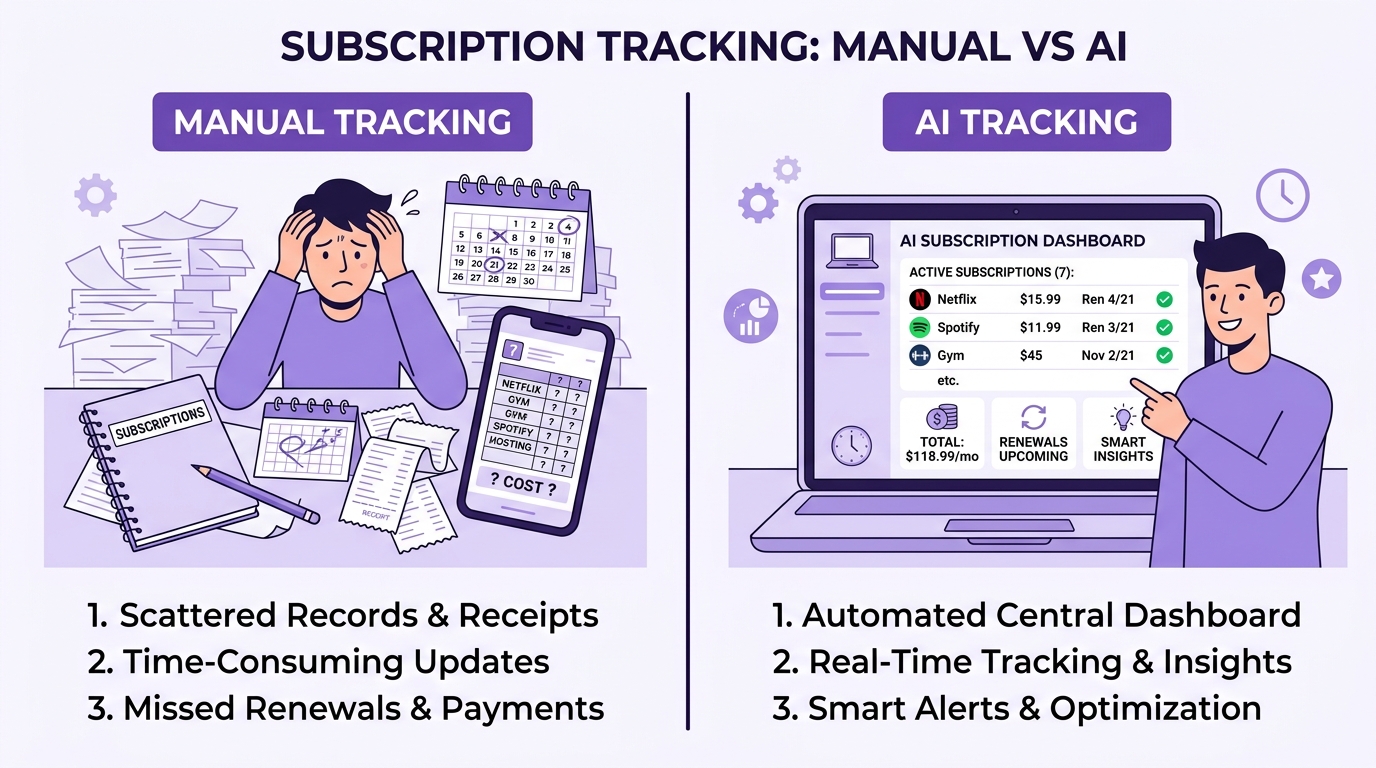
To understand the practical difference, consider what a manual subscription audit looks like versus the AI approach:
The Manual Audit
- Log in to each bank account and credit card separately
- Download 3-6 months of statements
- Scan every transaction line looking for recurring charges
- Cross-reference across accounts to avoid duplicates
- Research unfamiliar merchant names (is "AMZN MKTP US" a subscription or a one-time purchase?)
- Calculate monthly and annual totals
- Set calendar reminders for renewal dates
- Repeat every 2-3 months to catch new subscriptions
Total time: 2-4 hours per audit. Realistic frequency: once, maybe twice per year.
The AI Audit
- Connect your accounts (one-time setup, 5 minutes)
- The AI scans your full transaction history and surfaces all recurring charges
- Review the flagged subscriptions and decide which to keep or cancel
- Receive ongoing alerts for new subscriptions, price changes, and renewals
Total time: 15 minutes for initial review. Ongoing: zero effort — the AI monitors continuously.
The difference is not just time savings. The AI catches charges that humans routinely miss, especially small amounts under $5 and annual renewals that only appear once in a 12-month window. In a broader AI money management context, subscription tracking is one of the highest-ROI automated features because the savings are immediate and concrete.
How Much Can You Actually Save?
The savings vary by person, but the data is consistent across multiple studies:
- Average unused subscriptions per person: 3-5
- Average cost per forgotten subscription: $8-15/month
- Typical annual savings after AI audit: $200-480
- Price increase savings (from timely cancellation of inflated subscriptions): $50-100/year
- Free trial saves (cancelling before conversion): $30-80/year
For a household with two adults, these numbers roughly double. A family running a family budget app with subscription tracking can realistically recover $400-900 per year in unused or forgotten charges.
Getting Started: Your First AI Subscription Audit
If you have never done a subscription audit, here is the fastest path to finding forgotten charges:
- Connect your primary accounts. Start with the credit card and bank account you use most. Even a partial view will surface surprises.
- Review the AI's findings. The tracker will list every recurring charge it detected. Sort by "last used" or "lowest engagement" to find the forgotten ones first.
- Make keep/cancel decisions. For each subscription, ask: "Did I use this in the last 30 days? Would I sign up again today at this price?" If both answers are no, it is a candidate for cancellation.
- Set up ongoing monitoring. Enable alerts for new recurring charges, price increases, and upcoming renewals. This is where the AI pays for itself long-term — you never accumulate forgotten subscriptions again.
The best free budgeting apps in 2026 include subscription detection as a baseline feature. There is no reason to keep paying for services you are not using when the technology to find them is free.
Frequently Asked Questions
How much do forgotten subscriptions cost the average person?
Studies show the average person wastes $200-300 per year on forgotten or unused subscriptions. With 12+ active subscriptions being common, even a few forgotten $5-10/month charges add up quickly. An AI subscription tracker can surface these charges in minutes.
How does AI detect forgotten subscriptions?
AI subscription trackers analyze your transaction history to find recurring patterns. They identify charges that repeat monthly or annually, flag subscriptions you have not used recently, detect price increases, and surface free trials that converted to paid plans.
Can an app cancel subscriptions for me?
Some apps like Rocket Money offer cancellation assistance, but most AI trackers focus on detection and alerting. kNexo identifies the subscription, shows your annual cost, and gives you the information to cancel it yourself — a more transparent approach that avoids giving third parties account access.
What is the best free app to track subscriptions?
kNexo offers a free tier with AI subscription detection, bank sync, and spending categorization. The WhatsApp integration lets you ask about your subscriptions via message without opening an app. Other options include Copilot Money (iOS only, paid) and Monarch Money (no free tier).
Is it safe to connect my bank account to a subscription tracker?
Reputable trackers use read-only bank connections through aggregators like Plaid — they can see transactions but never move money. Look for 256-bit encryption and SOC 2 compliance. kNexo also supports manual logging via WhatsApp if you prefer not to connect bank accounts.
Find your forgotten subscriptions in 5 minutes.
kNexo's AI scans your transactions and surfaces the recurring charges you forgot about. No spreadsheets, no manual audits.
Create free account