How to Stick to a Budget: 12 Proven Strategies That Work
The problem is rarely the budget itself. It is the gap between planning and behavior.

Creating a budget takes twenty minutes. Sticking to one takes a complete shift in how you interact with money daily. According to a 2025 Bankrate survey, 55% of Americans do not follow a detailed budget, and among those who do, nearly half admit to regularly exceeding their limits. The issue is not intelligence or income level. It is that most budgets are built for a version of you that does not exist: perfectly rational, never impulsive, immune to social pressure According to Federal Reserve consumer spending data, this aligns with broader consumer-finance trends.
These twelve strategies address the actual psychological, logistical, and environmental reasons budgets fail. They are ordered from foundational to advanced. Start with the first three and add others as they become relevant.
1. Budget for Who You Actually Are
If you eat out three times a week, do not build a budget that assumes you will cook every meal. If you buy coffee every morning, do not pretend you will suddenly start brewing at home. Start with your real spending patterns and optimize from there. A budget that cuts your dining spending from $600 to $450 is achievable. A budget that cuts it to $100 is fiction.
Review your last three months of spending before setting any numbers. Your actual behavior is the baseline, not your aspirational behavior.
2. Use the 50/30/20 Rule as a Starting Point, Not a Straitjacket
Fifty percent needs, thirty percent wants, twenty percent savings. This framework is useful as a general orientation, but it breaks down in high cost-of-living areas where housing alone may consume 40% of income. Adjust the ratios to match your reality. The important thing is having clear categories with intentional limits, not hitting exact percentages.
3. Automate the Non-Negotiables First
On payday, before you spend anything, automatically transfer money to savings, retirement, and debt payments. What remains in your checking account is your actual spending money. This eliminates the daily willpower drain of deciding whether to save. The decision was made once, on setup day, and it executes itself forever.
Set up automatic transfers for your emergency fund, any savings challenges you are running, and minimum debt payments. Everything else is discretionary.
4. Give Yourself a Blow Money Category
Budget purists hate this advice. But having a category for guilt-free, no-questions-asked spending is one of the most reliable ways to prevent budget burnout. Call it "fun money," "blow money," or "personal discretionary." Set an amount you can genuinely afford, then spend it on anything without tracking or justifying.
This works because it acknowledges human psychology. Complete restriction leads to binge spending the same way extreme dieting leads to binge eating. A controlled release valve prevents the pressure from building to a breaking point.
5. Use Cash Envelopes for Problem Categories
Digital spending is painless. Tapping a card does not trigger the same loss aversion as handing over physical bills. If you consistently overspend in specific categories (dining, entertainment, clothing), withdraw that amount in cash at the start of the month and use only cash for those purchases. When the envelope is empty, you are done for the month.
This does not mean you need to go all-cash. Use it selectively for the two or three categories where you lose control. Keep everything else digital for convenience and tracking.
6. Check Your Budget Weekly, Not Monthly
A monthly budget review is an autopsy. A weekly check-in is a course correction. Spend five minutes every Sunday reviewing what you spent that week versus your targets. If you are trending over in dining, you have three weeks to adjust. Waiting until month-end to discover you overspent by $300 gives you zero time to fix it.
7. Remove Temptation from Your Environment
Unsubscribe from retailer emails. Delete shopping apps from your phone. Unfollow social media accounts that trigger comparison spending. Remove saved credit card numbers from online stores so you have to manually enter them (the friction alone stops many impulse purchases).
The easiest way to stop overspending is not to rely on willpower but to reduce the number of times you need to exercise it.
8. Plan for Irregular Expenses
Car registration, annual insurance premiums, holiday gifts, back-to-school supplies. These are not surprises. They happen every year. Yet most budgets treat them as unexpected expenses that blow the monthly plan.
List every irregular expense you can predict, total the annual cost, divide by 12, and add that amount to your monthly budget as a sinking fund. When the expense arrives, the money is already there. No budget crisis, no scrambling.
9. Build in a Buffer
Budget 90% of your income, not 100%. That remaining 10% absorbs the small overages, forgotten expenses, and rounding errors that accumulate every month. Without a buffer, every month feels like a failure because you always exceed your plan by some amount. With a buffer, those small overages are expected and accounted for.
10. Make Progress Visible
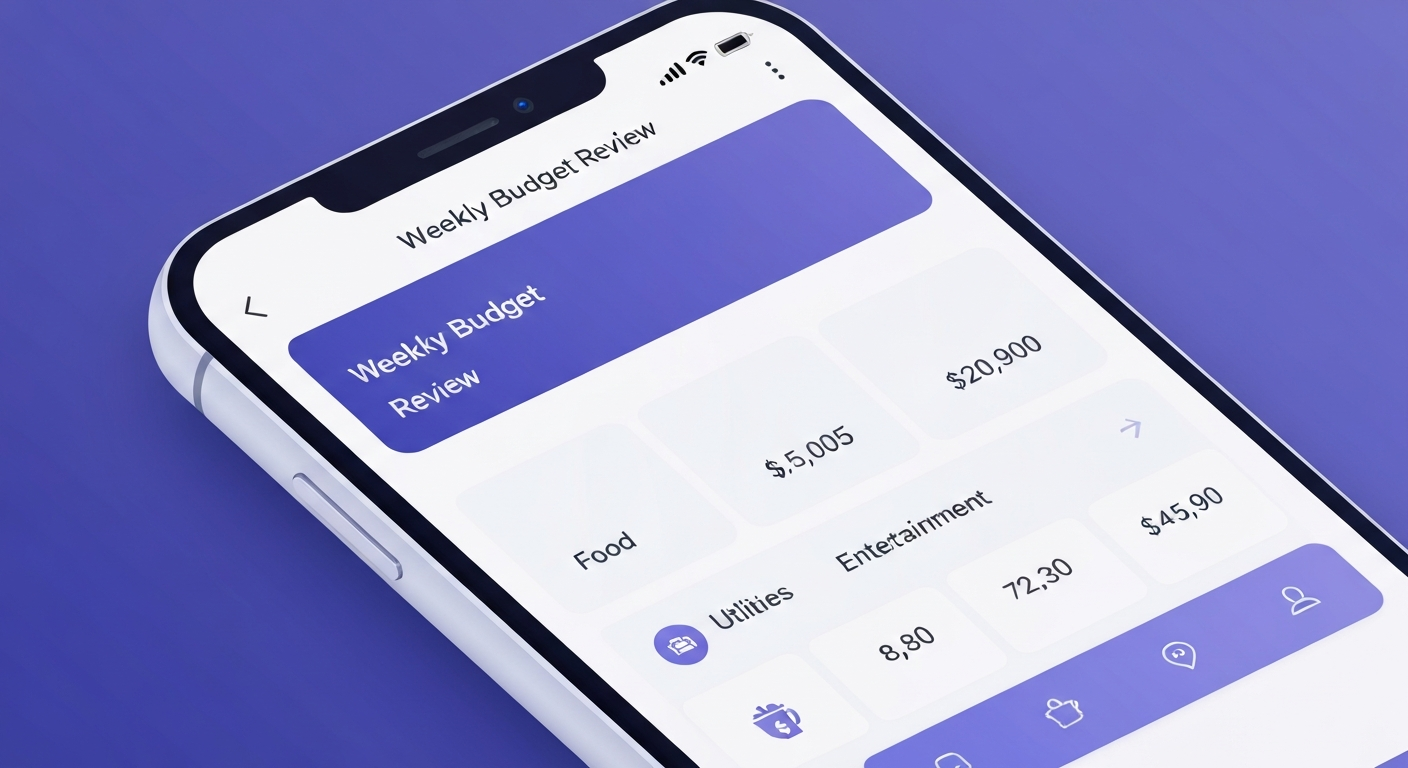
Humans respond to visual progress. A gamified budgeting app that shows your progress as a filling bar, a streak counter, or achievement badges leverages the same psychology that makes fitness trackers effective. When you can see that you are 22 days into a no-overspend streak, breaking it feels costly.
This is one area where AI budgeting apps genuinely outperform spreadsheets. Automated visual tracking that updates in real time removes the manual effort that causes most people to stop tracking altogether.
11. Have a Response Plan for Slip-Ups
You will overspend. It will happen. The question is not whether but what you do afterward. Without a plan, overspending triggers guilt, which triggers avoidance ("I already blew it, so why bother"), which triggers more overspending. This is the abstinence violation effect, well-documented in behavioral psychology.
Your response plan: acknowledge the overspend, identify which category absorbed it, adjust the remaining weeks to compensate where possible, and move on. No shame spiral. No abandoning the budget entirely. Just a calm correction.
12. Review and Adjust Quarterly
Your budget should not be a static document created in January and ignored by March. Every three months, review your category amounts and adjust based on what actually happened. Maybe you consistently underspend on groceries and overspend on gas. Shift the money to match reality. A budget that reflects your real life is one you can actually follow.
The Meta-Strategy: Reduce Friction
Every strategy above shares a common thread: reducing the friction between you and good financial behavior. The easier it is to track spending (automatic categorization via AI), the easier it is to save (automated transfers), the easier it is to stay motivated (visible progress and gamification), the more likely you are to stick with your budget long-term.
Tools like kNexo are designed around this principle. When logging an expense is as simple as sending a WhatsApp message, and your progress updates automatically with missions and achievements, budgeting stops feeling like a chore and starts feeling like a system that works for you instead of against you.
Frequently Asked Questions
What is the best budgeting method for beginners?
The 50/30/20 rule is the simplest starting point: 50% of income to needs, 30% to wants, 20% to savings and debt. It does not require tracking every purchase. Once you are comfortable with general categories, you can move to more detailed tracking with an app or zero-based budgeting if you want greater control.
How long does it take to build a budgeting habit?
Research from University College London suggests habit formation takes an average of 66 days, though the range is 18 to 254 days depending on the complexity of the behavior. For budgeting, most people find that if they can stick with weekly check-ins for three months, the habit becomes relatively automatic.
Should I budget with my partner?
If you share expenses, yes. Financial disagreements are a leading cause of relationship stress. A shared budget creates transparency and alignment. The key is having individual "personal spending" categories that each person controls without needing approval, combined with shared categories for joint expenses like rent, groceries, and utilities.
What do I do when my income is irregular?
Budget based on your lowest expected monthly income. In months where you earn more, direct the surplus to savings or debt. This prevents the feast-or-famine cycle where high-income months get spent freely and low-income months create stress. A flexible savings challenge approach works well here.
Ready to take control of your finances?
Join the kNexo waitlist for early access to AI-powered money management.
Create free account