Your Bank App vs. an AI Money Manager: What's Actually Different?
Your bank app shows what happened. An AI money manager tells you what to do about it. Here is how they compare and where each one falls short.
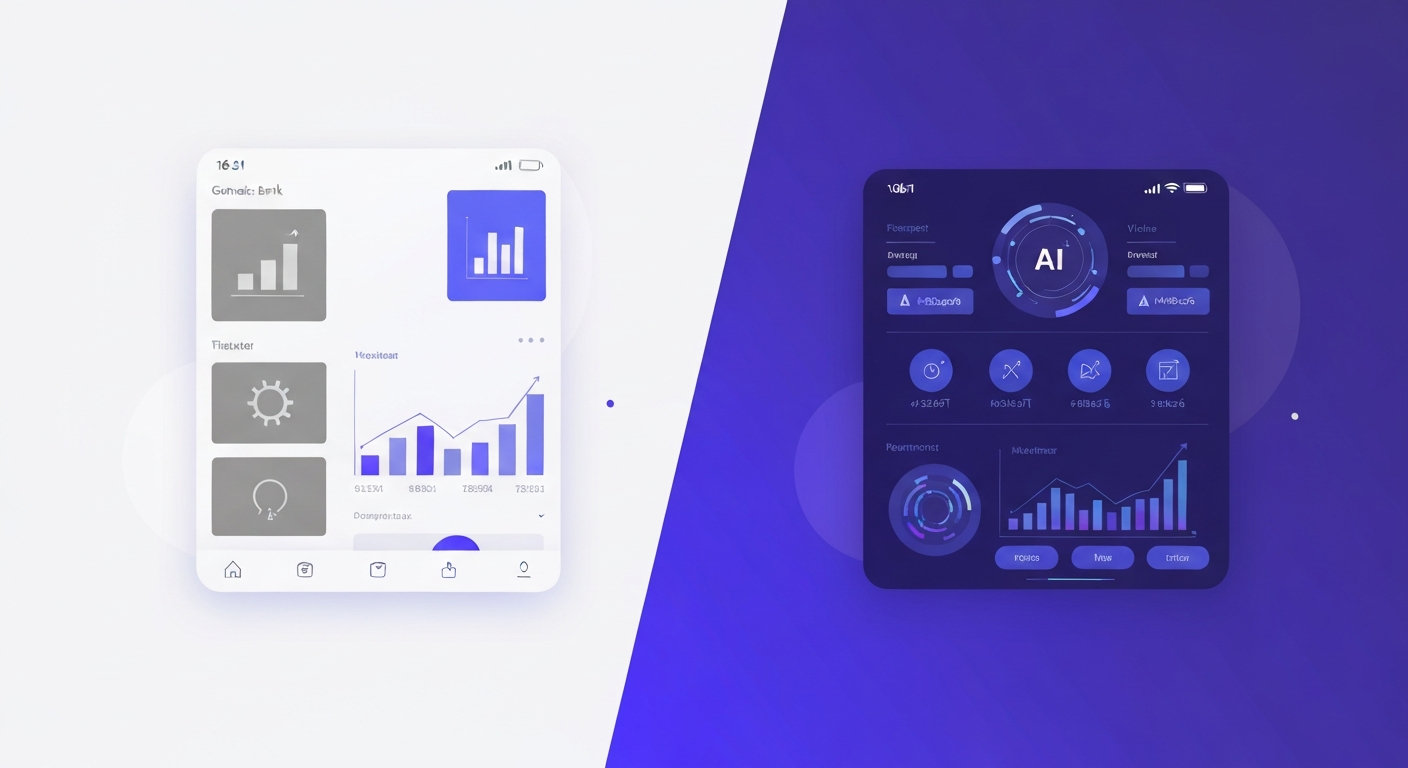
According to a Federal Reserve survey, 84% of American adults used a mobile banking app in the past year. Most of them check their balance, scroll through transactions, and close the app. That is the entire experience. Meanwhile, a growing category of AI money managers promises to do something bank apps never attempted: actually help you spend less, save more, and understand your financial patterns without requiring a finance degree.
But is that marketing hype, or is there a real functional gap between your bank app and an AI-powered alternative? The answer depends on what you need from your money tools. This article breaks down the concrete differences so you can decide whether your bank app is enough or whether an AI money manager fills gaps you did not realize existed.
What Your Bank App Actually Does (and Does Not Do)
Bank apps have improved dramatically over the past decade. Most major banks now offer mobile check deposit, instant transfers, spending summaries by category, and push notifications for large transactions. Some even provide monthly spending breakdowns with colorful pie charts.
Here is what they handle well:
- Balance checking across checking, savings, and credit accounts
- Transaction history with search and basic filters
- Bill pay and transfers between accounts
- Fraud alerts for suspicious activity
- Monthly summaries showing category-level spending totals
That list sounds comprehensive until you notice what is missing. Bank apps are passive record-keepers. They log what already happened. They do not predict what is about to happen. They do not notice that your grocery spending has crept up 22% over the last three months. They do not alert you on June 15th that your car insurance auto-renews in two weeks and you should budget for it. They do not suggest that switching your daily coffee habit to three times a week could save you $780 a year.
The Consumer Financial Protection Bureau has noted that financial well-being depends less on income level and more on day-to-day financial management behaviors. Bank apps give you the raw data but leave the behavior change entirely up to you.

How AI Money Managers Work Differently
An AI money manager does not replace your bank. It sits alongside your bank app and adds an intelligence layer that transforms raw transaction data into actionable guidance. The core differences fall into three categories.
Automatic Categorization That Actually Learns
Bank apps categorize transactions using merchant codes. This works for straightforward purchases but fails constantly. A payment to Amazon might be groceries, electronics, or a birthday gift. A Venmo transfer could be splitting rent or paying for dinner. Bank apps either guess wrong or dump everything into "Other."
AI money managers use machine learning to categorize transactions based on context, amount, timing, and your correction history. When you recategorize a transaction once, the system learns and applies that logic going forward. Over time, accuracy climbs above 95%, compared to the 60-70% typical of bank app auto-categorization.
Pattern Detection and Proactive Alerts
This is the biggest gap between bank apps and AI money managers. A bank app might tell you that you spent $1,200 on dining last month. An AI money manager tells you:
- Your dining spending is $340 higher than your three-month average
- Most of the increase came from Friday and Saturday nights
- At this rate, you will exceed your monthly budget by $520
- Reducing weekend dining by one meal out per week would bring you back on target
That is the difference between data and intelligence. The bank app gives you a number. The AI money manager gives you a diagnosis and a prescription.
The real question is not whether you can see your spending. You can. The question is whether your tools help you change your spending. That is where bank apps stop and AI money managers start.
Predictive Cash Flow
Most people run out of money before the month ends because they forget about irregular expenses. Annual subscriptions, quarterly insurance premiums, semi-annual dental visits. An AI money manager tracks these patterns and flags them before they hit. "Your $189 car insurance payment is due in 9 days. Your current balance can cover it, but you will need to reduce discretionary spending by $45 this week to stay on track for your savings goal."
Bank apps cannot do this because they are designed to show you the present, not model the future.
The WhatsApp-Native Advantage
One reason people abandon budgeting apps is friction. You spend money, then you have to remember to open a separate app, find the right category, type in the amount, and save. By day four of a new budget, most people stop bothering.
AI money managers like kNexo solve this by meeting you where you already are: WhatsApp. Instead of opening a dedicated finance app, you send a message the same way you text a friend:
- "Lunch $12.50" — categorized, logged, budget updated in seconds
- "How much did I spend on groceries this week?" — instant answer
- "Am I on track for my savings goal?" — real-time status with recommendations
This is not a minor convenience upgrade. Research from NerdWallet shows that consistent expense tracking is the single strongest predictor of staying within budget. The easier you make tracking, the more consistently people do it. WhatsApp messages take 3 seconds. Opening a bank app, navigating to the budget section, and manually adding a transaction takes 30-45 seconds. That difference compounds across dozens of daily transactions.
Gamification Makes the Habit Stick
Here is a fact that bank product managers rarely discuss: most people stop using budgeting features within 90 days. The initial motivation fades, the app becomes another ignored icon on the home screen, and spending habits revert to autopilot.
AI money managers with gamification mechanics address this retention problem directly. kNexo, for example, turns budget adherence into missions with tangible progress:
- Daily streaks for logging expenses consistently
- Savings missions like "Skip 3 takeout meals this week" with progress bars
- Achievement badges for hitting milestones (first $500 saved, 30-day streak, etc.)
- Weekly challenges personalized to your spending patterns
- Family leaderboards where household members can see shared progress
Bank apps offer none of this. They were designed for transactions, not for behavior change. The gamification layer is not a gimmick. It is a proven engagement mechanism that keeps users actively managing their money instead of passively watching it disappear.
Comparison Table: Bank App vs. AI Money Manager
| Feature | Bank App | AI Money Manager (kNexo) |
|---|---|---|
| Transaction history | Yes | Yes |
| AI categorization | Basic (merchant codes) | Advanced (learns from corrections) |
| Proactive spending alerts | No | Yes (pattern-based) |
| Predictive cash flow | No | Yes |
| WhatsApp expense logging | No | Yes (instant) |
| Gamification / missions | No | Yes (streaks, badges, challenges) |
| Family budget sharing | Joint accounts only | Yes (up to 6 members) |
| Personalized savings advice | No | Yes (behavior-based) |
| Bill pay and transfers | Yes | No (not a bank) |
| Price | Free (with your bank account) | Free forever / Pro $19.90/mo |
When Your Bank App Is Enough
Honesty matters here. Not everyone needs an AI money manager, and pretending otherwise would be misleading.
Your bank app is probably sufficient if:
- You have a stable income with predictable expenses and rarely overspend
- You already have a solid expense tracking habit using spreadsheets or another system
- Your financial goals are simple (one savings account, no debt payoff plan, no family coordination)
- You check your bank app daily and mentally track your spending without external help
If that describes you, an AI money manager adds convenience but may not dramatically change your financial outcomes. You are already doing the work manually.
However, if any of these sound familiar, an AI money manager fills a real gap:
- You have tried budgeting apps before and stopped using them within a few months
- You reach the end of the month wondering where your money went
- You share finances with a partner or family and lack visibility into combined spending
- You know you should be saving more but struggle with consistency
- You find traditional budgeting tools tedious and avoid opening them
The data supports this distinction. People who struggle with financial consistency are not lacking information. They are lacking the right delivery mechanism. An AI money manager provides that mechanism through proactive nudges, low-friction logging, and engagement loops that keep financial awareness top of mind.
The Bottom Line
Your bank app is a necessary tool. It handles the mechanics of banking: moving money, paying bills, checking balances. It was never designed to be a financial coach, and it shows.
An AI money manager like kNexo does not replace your bank app. It complements it by adding the intelligence layer that turns passive data into active guidance. Automatic categorization that improves over time. Proactive alerts before you overspend. WhatsApp-native logging that takes seconds instead of minutes. And gamification that turns budgeting from a chore into something you actually want to do.
The free tier gives you unlimited transactions, AI categorization, and savings missions at $0 forever. The Pro plan at $19.90/month (annual billing) adds Copilot, Smart Insights, and full WhatsApp 2-way sync with a 14-day free trial. For families, the plan covers up to 6 members for $29.90/month.
Ready to see what your bank app is missing?
Start tracking expenses on WhatsApp in under 60 seconds. Free forever, no credit card required.
Create free account →Frequently Asked Questions
Is an AI money manager safe to use?
Yes. Reputable AI money managers use bank-level encryption for all data. kNexo takes a privacy-first approach: you log expenses via WhatsApp messages, so the platform never needs your bank login credentials. Your financial data is encrypted at rest and in transit.
Can an AI money manager replace my bank app?
No, and it should not. Your bank app handles transactions, transfers, and account management. An AI money manager adds an analysis and coaching layer on top. Think of it as the difference between a thermometer (your bank app shows the temperature) and a thermostat (an AI money manager adjusts the temperature). You need both.
How much does kNexo cost?
kNexo offers three tiers. Free: $0 forever with unlimited transactions, AI categorization, and missions. Pro: $19.90/month (annual) or $29/month (monthly) with a 14-day free trial, including Copilot, Smart Insights, and WhatsApp 2-way sync. Family: $29.90/month (annual) or $49.90/month (monthly) for up to 6 members.
Does kNexo connect to my bank account?
kNexo does not require bank account connections. You log expenses by sending a WhatsApp message like "Coffee $4.80" and the AI categorizes it instantly. This approach is actually faster than waiting for bank transaction syncs (which can take 1-3 days) and works with any bank or payment method worldwide.
What can an AI money manager do that my bank app cannot?
The core differences are proactive spending alerts (before you overspend, not after), intelligent categorization that learns your habits, personalized savings recommendations based on your actual spending patterns, predictive cash flow modeling, and gamified challenges that keep you engaged long-term. Bank apps show data. AI money managers act on it.